Site logo linking the user to the homepage Site logo linking the user to the homepage
SEARCH

Prostate Specific Antigen (PSA)

The prostate produces a protein called prostate-specific antigen (PSA). PSA helps to make your semen more liquid. Some PSA leaks into your blood. How much will depend on:

  • Your age – it raises slightly as you get older and your prostate grows
  • The health of your prostate.
Listen

What is a PSA test?

A PSA test is a simple blood test. This measures the amount of PSA in your blood. The test only takes a few minutes and can be done at your GP surgery. 

What is PSA?

The prostate produces a protein called prostate-specific antigen (PSA). PSA helps to make your semen more liquid. Some PSA leaks into your blood. How much will depend on:

  • Your age – it raises slightly as you get older and your prostate grows
  • The health of your prostate.
Image
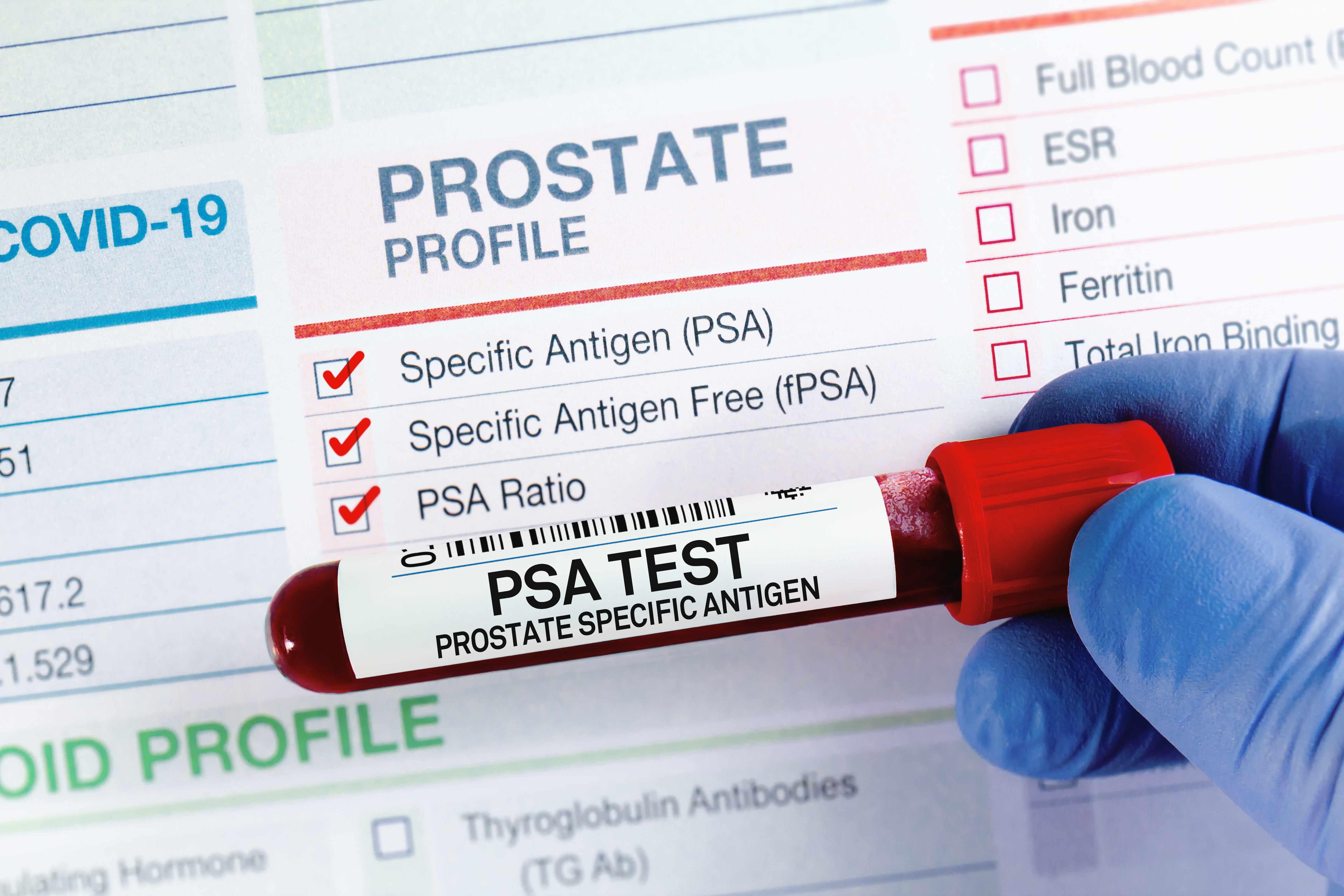
PSA blood test

 What can a PSA test tell me? 

  • A PSA test can help show if you may have a problem with your prostate, including prostate cancer. 

  • A high PSA level does not always mean you have prostate cancer. 

  • PSA levels can be higher because of other prostate problems, such as an enlarged prostate or an infection. 

  • A normal PSA level does not always mean there is no prostate cancer. 

  • If your PSA level is high, your GP will talk to you about what it means and whether you need more tests. 

  • These tests may include an MRI scan, a prostate biopsy, or both 

Important things to know

Should I speak to my GP about a PSA test?

If you have symptoms that could be caused by prostate cancer 

Speak to your GP if you have symptoms such as: 

  • Needing to pass urine more often. 

  • A sudden urge to pass urine. 

  • Getting up more often during the night to pass urine. 

  • Difficulty starting or stopping urination. 

  • Blood in your urine. 

  • Problems getting or keeping an erection. 

  • Ongoing pain in your back, hips or pelvis. 

  • Feeling very tired all the time. 

  • Unexplained weight loss. 

If you have a BRCA2 gene variant 

If you have a BRCA2 gene variant, your risk of developing prostate cancer is higher than average.  

The UK National Screening Committee recommends PSA testing every 2 years for men aged 45 to 61 who have a BRCA2 gene variant and a family history of breast, ovarian, pancreatic or prostate cancer. 

You do not need to have symptoms. Speak to your GP or specialist about PSA testing. 


How do I know if I have the BRCA gene variant? 

If one of your parents, brothers, sisters or children has a BRCA gene variant, you may benefit from genetic testing. Speak to your GP or specialist for advice. 


If you do not have symptoms but are worried about prostate cancer 

Speak to your GP. They will talk to you about your concerns and ask about things that may affect your risk of prostate cancer, such as your family history. 

Your GP will explain the benefits and limitations of a PSA test. Together, you can decide whether a PSA test is right for you. 


What can help me decide whether I should ask for a  PSA test?

You can speak to your GP. They will talk to you about your risk. 

  • There are risk calculators that can help you check your risk of prostate cancer. This can help you to decide whether to ask for a PSA test. 
  • Prostate Cancer UK have a risk checker (link will open in a new tab) that you can use online (this will open in an external tab). If this suggests that you may be at risk, come back to the infopool and visit our testing and diagnosis page (link will open in a new tab) to see what you can do next.

Black Father and son looking at an iPad

What does my PSA result mean?

PSA is measured in nanograms per millilitre (ng/mL) or micrograms per litre (µg/L). These units are equivalent. 

PSA levels can vary with age. Your PSA result should be interpreted alongside your age, symptoms and other health information. 

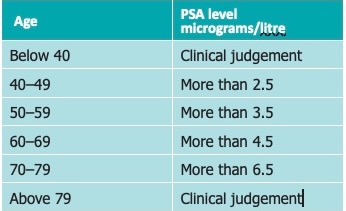
PSA results and your age 

Age-specific PSA levels for people with possible symptoms of prostate cancer. National Institute for Health and Care Excellence (NICE) 2023 


For men under 40 and aged 80 or over, PSA results need to be looked at alongside symptoms and other health information. Your GP will decide if any further tests are needed 

If my PSA is high do I have prostate cancer?
  • No. A high PSA level does not always mean you have prostate cancer. 

  • About 1 in 4 men with a PSA level between 4 and 10 ng/mL will be diagnosed with prostate cancer. 

  • A PSA test alone cannot usually confirm whether or not you have prostate cancer. If your PSA level is high, you may need more tests, such as an MRI scan or a biopsy. 


Other reasons why your PSA level may be high include: 

  • An enlarged prostate, which becomes more common as you get older. 

  • A urine infection. 

  • Recent ejaculation. (sex or masturbation) 

  • Cycling, running or other vigorous exercise in the 48 hours before your PSA test.  

Frequently asked questions (FAQs) about the PSA test
Do I need to prepare for a PSA test?

If you are having a PSA test as part of a general health check-up or screening, you will be asked to avoid the following for 48 hours before your PSA test:

  • Exercising heavily 
  • Sexual activity.
black man on bicycle
What is the guidance for PSA tests in men aged over 80?
Older man talking to his GP


  • Many men over the age of 80 may be found to have some cancer in their prostate. However, it often doesn't cause problems or need treatment.
  • There is national guidance for GPs to help guide whether a man over 80 years old should routinely have a PSA test. According to this guidance you should be able to have a PSA test if:
    • You have an expected life expectancy of 10 years or more AND
    • You can undergo treatment with radiotherapy (this links to our radiotherapy information page) if prostate cancer that needs treatment was found. There are medical problmes that mean that you may not be able to have radiotherapy e.g.
      • Major problems with peeing (particulary problems with peeing a lot or needing to pee in a hurry).
      • An inflamed bowel (colitis)
      • Not being able to lie flat for a few minutes for treatment.
    • If you have unexplained bone pain or significant weight loss. This could mean you have prostate cancer that has spread to your bones. This is called metastatic disease. You can have treatment that may help with your symptoms, but will not cure your prostate cancer.


I've had a PSA test. What level must it reach before I am referred to a specialist?

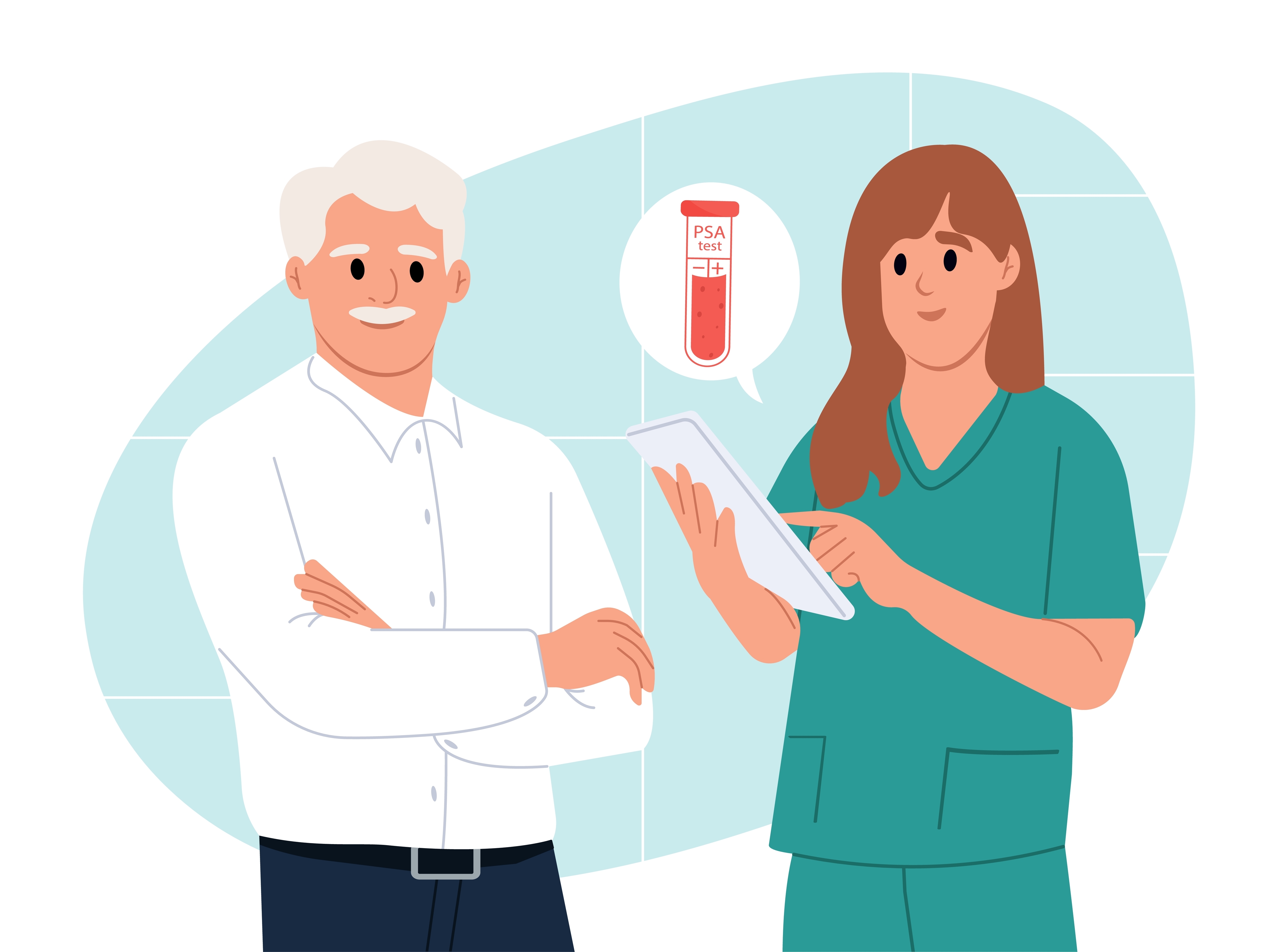
Female doctor speaking to older man with image of blood in a psa test tube

  • If you have had a PSA test you may be referred to a specialist if:
    • Your PSA is over 20ng/ml; OR
    • Your PSA is over 7.5ng/ml AND you have symptoms that suggest that you may have metastatic disease. This includes:
      • Bone pain and/or
      • Fatigue and/or
      • Significant weight loss. 


What happens if your first PSA test is between 7.5-20ng/ml and you have no symptoms of metastatic disease?

  • Your GP may repeat the PSA test after six months.
  • You may be referred to a specialist if you have developed symptoms or
  • Your PSA has increased a lot (more than doubled). 

Taking this information with you may help guide the discussion with your GP. 

What else can cause high levels of PSA in the blood?

The PSA can be raised for many reasons: 

  • An infection of your pee (urinary tract infection or UTI): You may be advised to wait for six weeks after a UTI before having a PSA test. 
  • Stimulation or massaging of your prostate: This can include:
    • Heavy exercise – especially cycling 
    • Ejaculation
    • Receiving anal sex.
  • Enlarged prostate (benign prostate hyperplasia or benign prostatic enlargement). It is normal for your prostate to grow as you get older. If it gets too big, you may have problems passing pee.
  • Prostatitis. Sometimes, bacteria can get into your prostate. This causes your prostate to get inflamed.
  • Medicines. Some medicines can affect your PSA levels. Talk to your GP or nurse about your medicines before having the PSA test.
pills in a bottle
  • Other tests. If you have had a prostate biopsy, you will need to wait six weeks before having a PSA test. 
What are the advantages of having a PSA test?
  • If the test result is ‘normal’ you may feel reassured.
  • It can help to pick up prostate cancer before you get any symptoms.
  • It can help to pick up fast-growing prostate cancer at an early stage. This means you can have treatment that could stop your cancer from spreading or causing problems.
What are the disadvantages of having a PSA test?
  • It is not 100% accurate:
    • You may have a high PSA but not have prostate cancer
    • You may have a normal PSA but have prostate cancer.
  • You may have a slow-growing prostate cancer that would never have caused any problems or shortened your life. This can cause unnecessary worry and stress. 
  • If your PSA is raised, you may need other tests such as, a prostate biopsy. This can cause pain, infection and bleeding. 
Community Testing Events
Thinking about going along to a community PSA testing event?

Some organisations offer community PSA testing events. If you are concerned about prostate cancer, your GP can discuss your symptoms, concerns and personal risk factors with you. If a PSA test is recommended, it can be arranged free of charge through the NHS.  

Before attending a community PSA testing event, make sure you know: 

  • Whether there will be an experienced nurse or doctor available to discuss your concerns. 

  • How your PSA test will be carried out. 

  • Whether your blood sample will be sent to a laboratory or tested at the event. 

  • How the quality of the testing process is checked. 

  • How and when you will receive your results. 

  • What your result means. 

  • Whether you need any follow-up tests. 

  • Whether your GP will be told the result, or if you need to tell them yourself. 

  • Who to contact if you have questions or concerns. 

A PSA result on its own cannot diagnose or rule out prostate cancer.  

If you have symptoms or are worried about prostate cancer, speak to your GP even if your PSA test result is normal. 


Home Testing Kits
Thinking about using a home PSA test?

If you are concerned about prostate cancer, we recommend speaking to your GP rather than using a home PSA testing kit. Your GP can discuss your symptoms, concerns and risk factors with you. If a PSA test is recommended, it can be arranged free of charge through the NHS.  

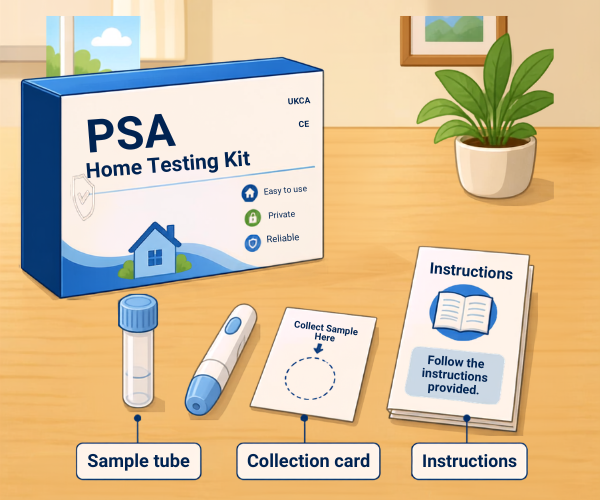
PSA home testing kits are available to buy online and from some pharmacies. 

If you choose to use a home testing kit, check that it has a CE or UKCA mark and follow the manufacturer's instructions carefully. A CE or UKCA mark shows that the test meets safety and quality standards. It does not mean that the test can tell you if you do or do not have prostate cancer, or that it is as accurate as an NHS laboratory test.  

A home PSA test cannot diagnose prostate cancer. A high PSA level can be caused by several conditions, including an enlarged prostate, inflammation or an infection.  

A normal PSA result does not rule out prostate cancer, and a high PSA result does not always mean cancer is present. 

If you have symptoms or are worried about prostate cancer, speak to your GP even if your home test result is normal. 
 

About this information

  • This information was revised in August 2026. It will be reviewed in August 2027.
  • References and bibliography available on request.
  • If you want to reproduce this content, please see our Reproducing Our Content page (link will open in a new tab).

Share your story with others

By sharing your experience of prostate cancer on the infopool you can help others. Your experience is valuable as they go through their own journey. Help make the prostate cancer community stronger.

Share story

Using Translation Tools

If you choose to use an AI tool, online translator, mobile app, or other translation service to translate this information, please be aware that translations may not always be accurate. Important medical terms, instructions, risks, or advice may be translated incorrectly or lose their intended meaning. 

We cannot accept responsibility for any errors, omissions, or misunderstandings resulting from the use of third-party translation tools. If you are unsure about any information, please contact your healthcare team.

Prostate Cancer Research logo
  • Privacy
  • Terms
  • Policies
  • Contact us
  • About infopool
  • Accessibility statement
  • Info for HCPs

Prostate Cancer Research,
2nd Floor, Fox Court
14 Grays Inn Rd
London, WC1X 8HN

Facebook Instagram Twitter LinkedIn Youtube

The information on the Infopool has been gathered from a number of sources. 
All our content is in line with accepted national or international clinical guidelines, including those from the National Institute for Health and Care Excellence (NICE). 


Where such guidelines do not exist, information is based on consensus from expert members of our Clinical Advisory Board.

Copyright 2026, All rights reserved. Registered Charity No: 1156027 

Site design by IE Digital

Main navigation
  • Home
  • Testing and Diagnosis
    • Prostate and you
    • Explore Diagnostics
    • Testing and diagnosis tool
    • Grading and Staging
  • Treatment and Care
    • Cancer Waiting Time Standards
    • Explore Treatments
    • Understand treatment choices
    • Prostate cancer treatment information webinars
    • Shared Decision Making
    • Palliative (supportive) care
    • End-of-life care
    • Mastering healthcare conversations
  • Stories
    • Share your story
    • Patient stories
    • Partners & carers
    • Living with side effects
  • Side Effects
    • Getting support for long-term effects of hormone therapy
    • Living with side effects
    • Emotional and Psychological Support
    • Getting support for peeing problems
    • Managing hot sweats and fatigue with hormone therapy
    • Getting support for sexual problems
    • Late effects of radiotherapy treatment
  • Partners and Carers
    • Partners and Carers
  • Research and Trials
    • Find clinical trials near me
    • Join Prostate Progress
Donate
User account menu
  • Log in
Powered by Prostate Cancer Research Prostate Cancer Research Logo